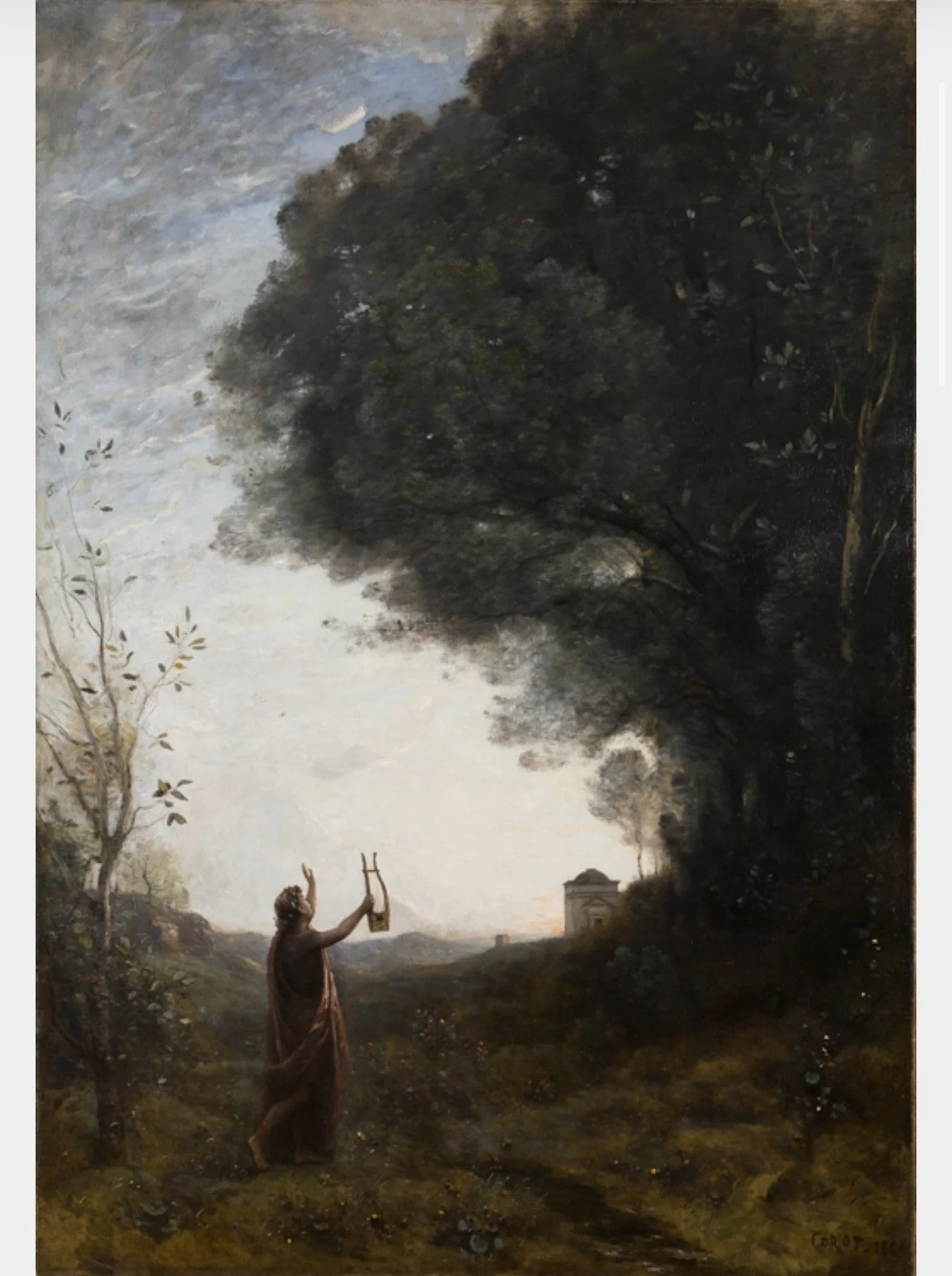
The Chazen Museum is a local gem for me. I enter the spacious atrium, light pouring in through tall windows, and I always walk straight to the third floor. At the top of the stairs, the first painting that greets me is Corot’s Orpheus Greeting the Dawn. It is a beautiful curatorial decision, whether conscious or not. You move from one airy architectural space into another painted one.
The canvas is tall and narrow, a vertical threshold. Within that elongated format, Corot places his two “protagonists” almost humbly: Orpheus in the lower left corner, perhaps one fifth the height of the composition, and the sun reduced to two modest strokes of drab orange near a small temple in the distance.
Two tiny gestures.
The rest of the painting is sky and a vast, dark plume of trees.
Although the myth suggests heroism, Corot quietly shifts the emphasis. The true force in this painting is not Orpheus. It is not even the sun. It is atmosphere. It is the immense interplay between light and dark that dwarfs them both.
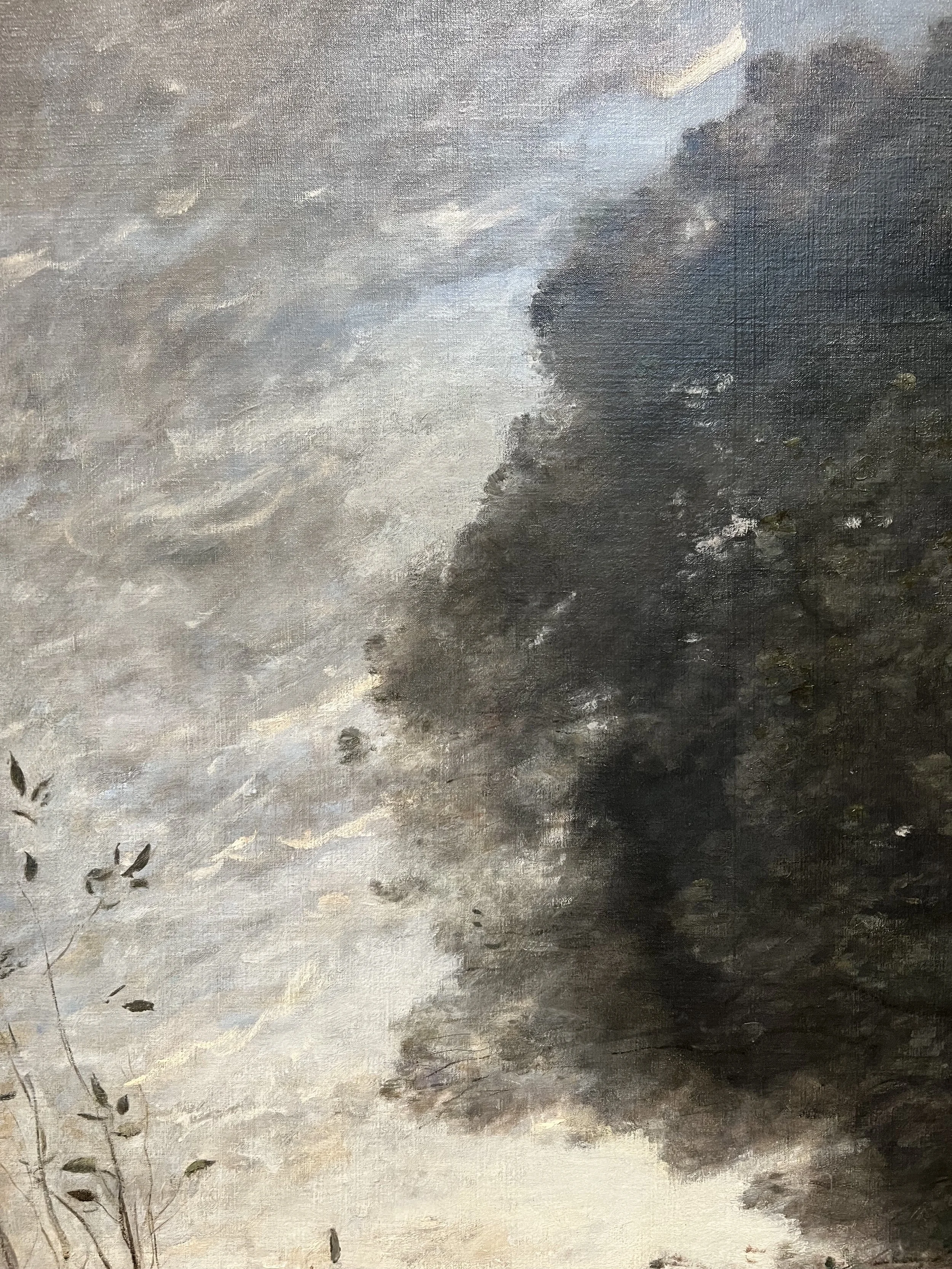
The upper register of the painting is extraordinary. The pale light of the sky and the black mass of foliage interlock in a shape that feels almost like an inverse yin and yang. Light presses into darkness. Darkness cups the light. The sun will rise and fill that space, and it will descend again. The painting holds both movements at once.
Standing in front of it, I feel the humility of scale. Orpheus, the quintessential artist, the mythic musician who could enchant animals, rocks, even the underworld, is small. He raises his lyre toward Apollo, toward light, toward art itself. And yet Corot shows us something larger than artistic genius. There is an all-pervasive space that exceeds the hero’s control.
The painting holds both triumph and insignificance.
As a viewer, I can drop down into the lower left and stand beside Orpheus, relating to the human gesture of devotion and longing. Then I can lift my eyes into the sky and rest. The painting allows both identification and dissolution.
Corot’s hand is extraordinary in its subtlety. The trees are massed, yet their edges soften and breathe. The foliage dissolves into atmosphere. He massages the surface without contrivance. Nothing feels labored. Nothing feels overly announced.
In the grasses below, small dashes of rose flicker across the earth. They are not fussy or overworked. A flick of the wrist. The right red in the right place. Done.
His palette is earthy yet sensual. The sky operates within a remarkably close tonal range. The yellows and blues are neighbors. Because the difference is primarily temperature rather than value, the sky vibrates without shouting. It breathes.
The color of the sun is one of Corot’s quiet miracles. Surrounded by cool blues and deep greens, those two small orange strokes appear incandescent, almost blinding. Yet if you isolated that same orange on a neutral gray or white, it would not read as particularly vivid. Its luminosity is relational. It glows because of what surrounds it.
That feels like a profound lesson in painting and perception.
Nothing shines alone.
Corot gives us a hymn to the sun that is also a hymn to atmosphere, to relational color, to scale, and to the humility of the artist within a larger field of forces.
Every time I see this painting, I feel grateful. It is the perfect work to encounter at the top of a staircase, after entering a luminous building, before moving on to the rest of the museum. It reminds me what painting can do: it can hold the human and the infinite in the same vertical breath.
Perhaps that is why Orpheus raises his instrument. Not to dominate nature, but to participate in it, to let it move through him, to rest within luminous space.