• 2016
    • 2017
    • 2018
    • 2019
    • 2020
    • Land Paintings 2022
    • Land Paintings 2023
    • Land Paintings 2024
    • Yala Yatra 2025
    • Lake Wingra 2025
  • Sky Paintings 2019-2024
  • Drawings 2020
  • Collaboration 2018
  • CV
  • Statement
  • On Painting
  • Contact
Menu

Peter Makela

Street Address
City, State, Zip
Phone Number

Your Custom Text Here

Peter Makela

  • YearBook
    • 2016
    • 2017
    • 2018
    • 2019
    • 2020
  • Land Paintings
    • Land Paintings 2022
    • Land Paintings 2023
    • Land Paintings 2024
  • 2025
    • Yala Yatra 2025
    • Lake Wingra 2025
  • Sky Paintings 2019-2024
  • Drawings 2020
  • Collaboration 2018
  • CV
  • Statement
  • On Painting
  • Contact

Exile and the Blooming Branch

March 8, 2026 Peter Makela

It is rare to walk into a gallery and encounter a painting that mirrors an internal experience. Something you have felt deeply, something you know in your bones, suddenly appears before you, shared in a beautiful and poetic way. That is one of the highest forms of art.

It is even rarer when the artist is someone you have never encountered before. In that moment two things happen simultaneously. You recognize something profoundly true within yourself, something you may not have had words for before, and at the same time you discover an artist whose work immediately matters to you. It is a beautiful and profound experience.

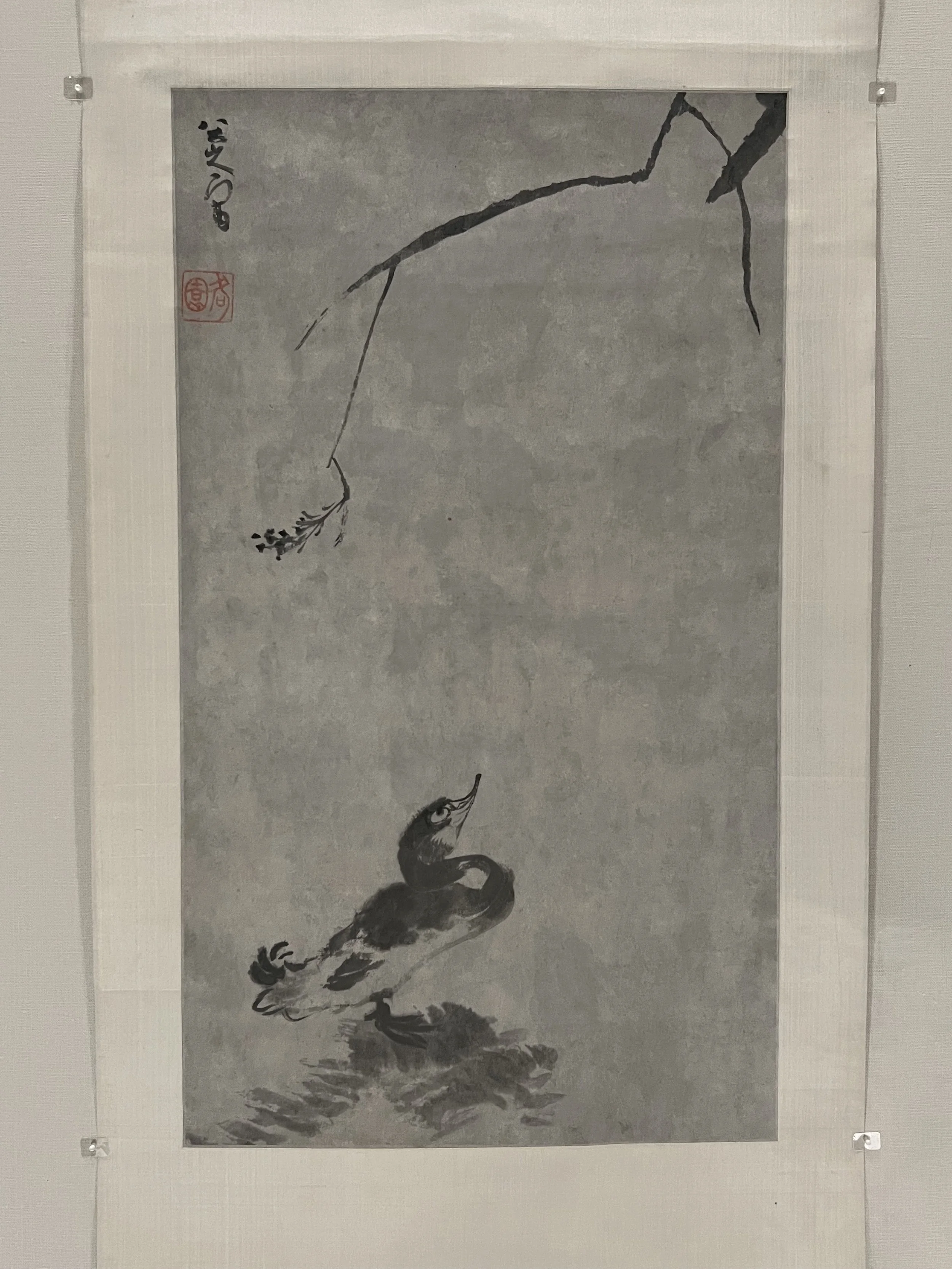
I had that experience with this painting in the Hong Kong Museum of Art by Zhu Da. I was absolutely floored by it.

Every stroke feels perfect. Each mark carries years of lived experience and wisdom within the practice of brush and ink on paper. None of the brushstrokes feel contrived or stylistic in a superficial way. They feel felt. They feel real. They feel true.

There is something deeply whimsical about this painting, yet also deeply sad. The signature itself carries that paradox. It resembles the characters 哭之笑之 (ku zhi xiao zhi), which roughly means crying and laughing at it. That phrase seems to hold the spirit of the work. There is despair intertwined with humor, a quiet recognition of the absurdity of existence. Perhaps one can feel pain deeply without necessarily suffering. The painting seems to hold that paradox.

The duck is gorgeous. Its face holds many emotions at once. I also love the line of the branch above. It reads both as branch and as a mountain-like form, two branches or perhaps one continuous gesture. Even within the melancholy of the scene, the blossoms bloom. Even in sadness there is renewal. Life continues. It is cyclical.

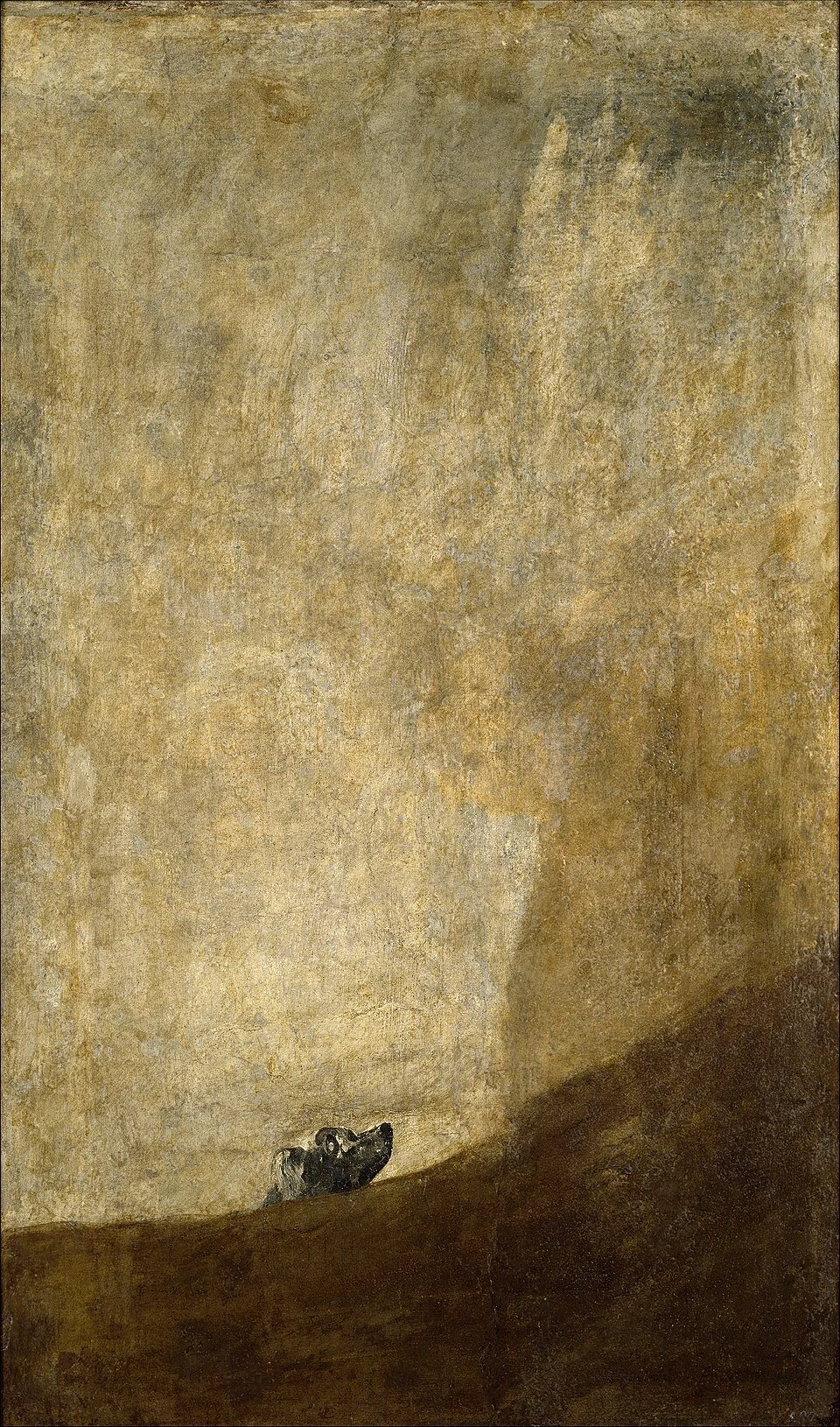
The painting also reminds me of that extraordinary image by Francisco Goya from the The Black Paintings series, the The Dog. There are surprising correspondences between the two works. Both figures sit low in the composition, looking upward into a vast space. Both evoke a quiet sadness and vulnerability, but also something more complex, perhaps even a form of surrender.

What also feels striking is that both of these figures exist in a kind of exile. Zhu Da was a descendant of the Ming imperial family who became a monk after the fall of the dynasty, while Goya too experienced a fall from favor after once being closely connected to the Spanish court. Both artists knew what it meant to move from proximity to power into a position of distance and isolation.

There is something humbling about that movement, about being close to power and then suddenly cast aside. Both paintings seem to hold that condition. These small animal figures become quiet stand-ins for the human condition, beings subject to forces much larger than themselves.

In both images the creature appears fragile within a vast surrounding space. The duck sits low beneath an immense wash of atmosphere. Goya’s dog emerges from a field of emptiness. In each case there is a huge spaciousness that makes the figure feel small within the greater elements of existence.

And yet there is also awareness in these figures. A knowingness. The duck’s upward glance carries something deeply human: a woundedness perhaps, but also attention and curiosity. The same can be felt in Goya’s dog. They seem aware of their position within the larger order of things.

What is so profound is how little is required to convey this. A few brushstrokes. A small form placed within an immense field. Through this economy both artists create a space where vulnerability, humility, and acceptance coexist.

There is sadness here, but it is not despair. It feels closer to a recognition of one’s place within the larger forces of life. And in that recognition there is something quietly peaceful.

What moves me most is the poetry of it. It is a painting I feel I could return to again and again.

Even the wash in Zhu Da’s painting is extraordinary. The subtle grey atmosphere feels alive. Every brushstroke carries a sensitivity and intelligence that I find deeply beautiful.

I am completely in love with this painting, it is perfect. 

Nothing Shines Alone

February 27, 2026 Peter Makela

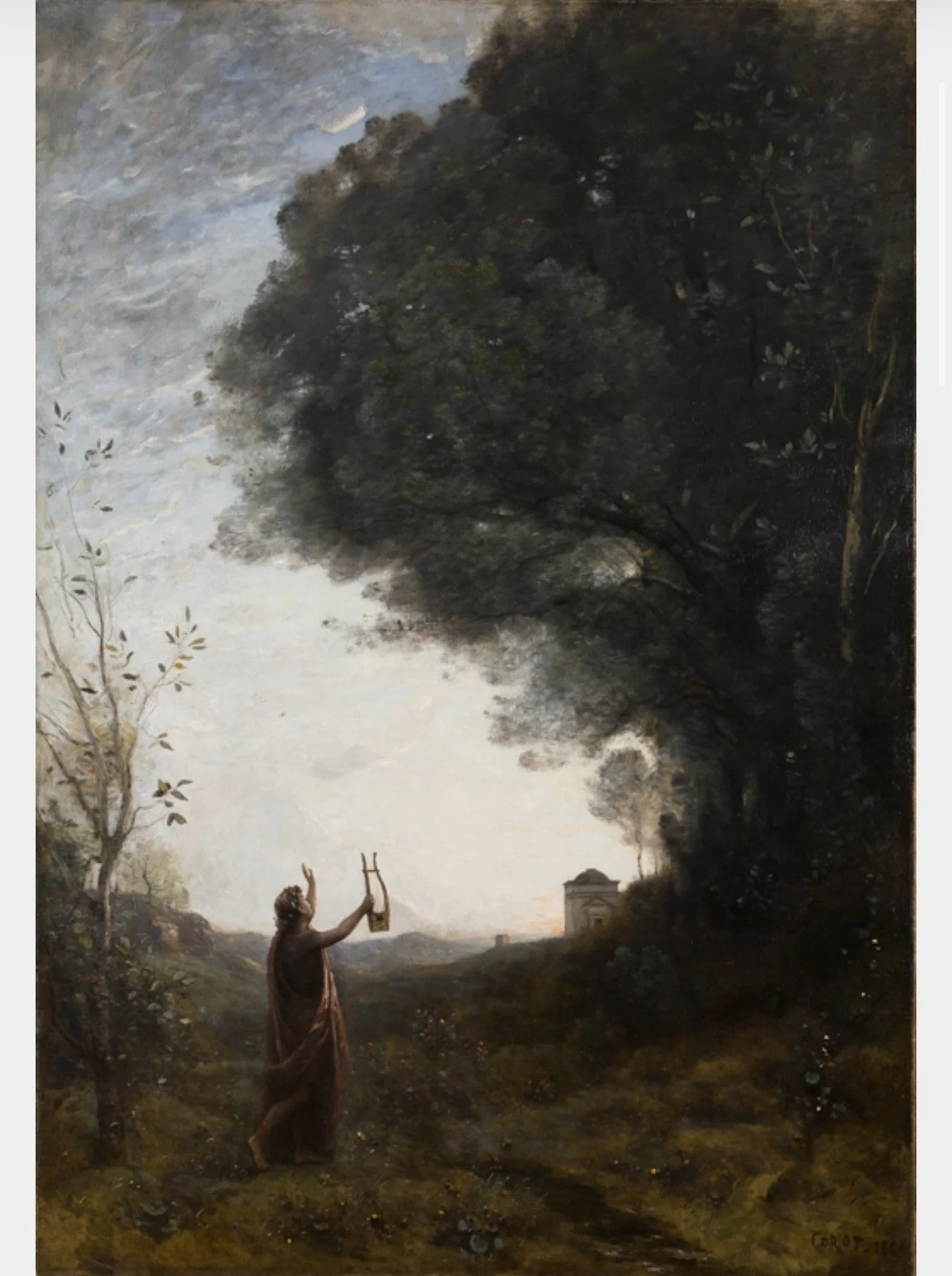
The Chazen Museum is a local gem for me. I enter the spacious atrium, light pouring in through tall windows, and I always walk straight to the third floor. At the top of the stairs, the first painting that greets me is Corot’s Orpheus Greeting the Dawn. It is a beautiful curatorial decision, whether conscious or not. You move from one airy architectural space into another painted one.

The canvas is tall and narrow, a vertical threshold. Within that elongated format, Corot places his two “protagonists” almost humbly: Orpheus in the lower left corner, perhaps one fifth the height of the composition, and the sun reduced to two modest strokes of drab orange near a small temple in the distance.

Two tiny gestures.

The rest of the painting is sky and a vast, dark plume of trees.

Although the myth suggests heroism, Corot quietly shifts the emphasis. The true force in this painting is not Orpheus. It is not even the sun. It is atmosphere. It is the immense interplay between light and dark that dwarfs them both.

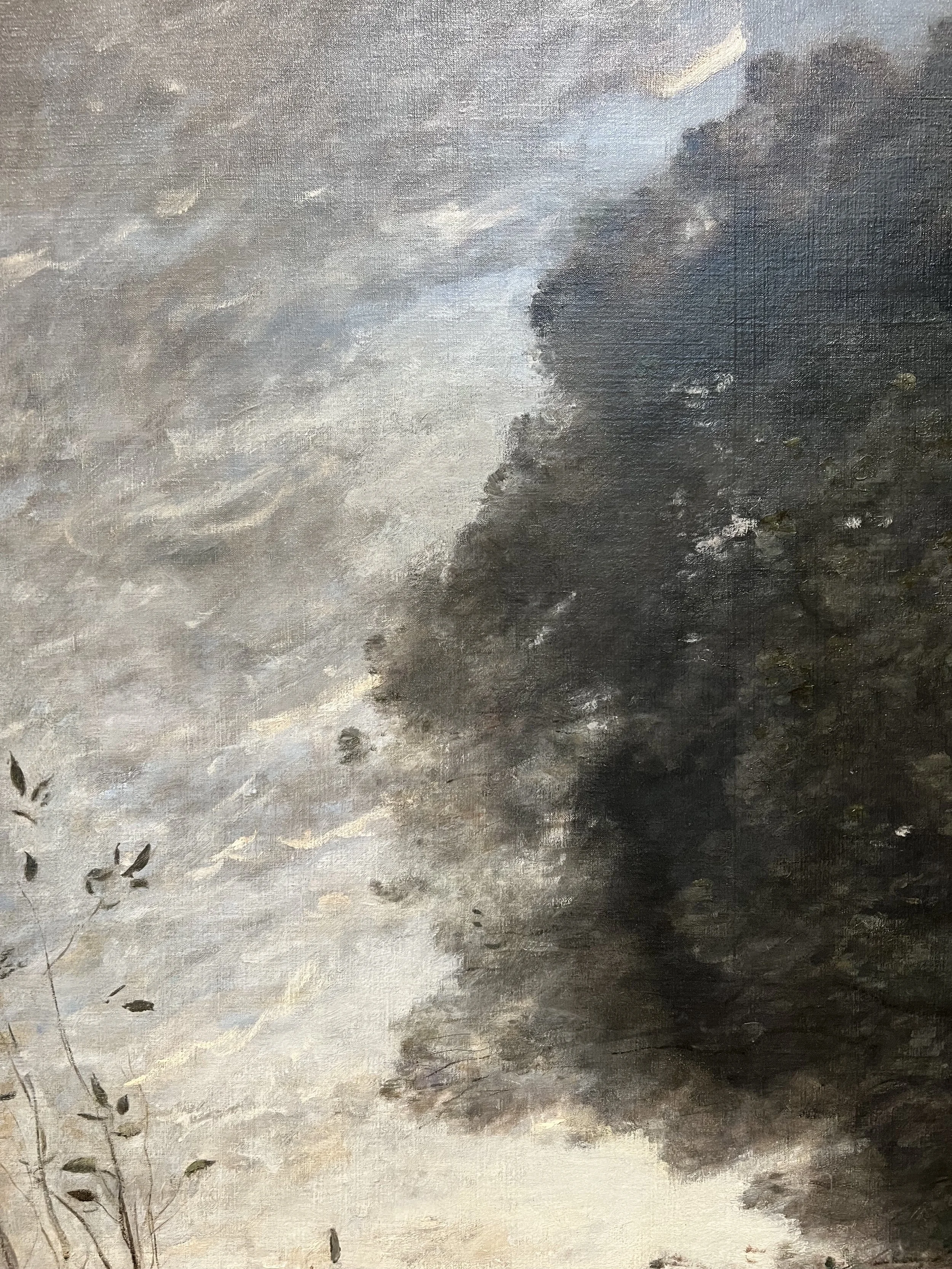
The upper register of the painting is extraordinary. The pale light of the sky and the black mass of foliage interlock in a shape that feels almost like an inverse yin and yang. Light presses into darkness. Darkness cups the light. The sun will rise and fill that space, and it will descend again. The painting holds both movements at once.

Standing in front of it, I feel the humility of scale. Orpheus, the quintessential artist, the mythic musician who could enchant animals, rocks, even the underworld, is small. He raises his lyre toward Apollo, toward light, toward art itself. And yet Corot shows us something larger than artistic genius. There is an all-pervasive space that exceeds the hero’s control.

The painting holds both triumph and insignificance.

As a viewer, I can drop down into the lower left and stand beside Orpheus, relating to the human gesture of devotion and longing. Then I can lift my eyes into the sky and rest. The painting allows both identification and dissolution.

Corot’s hand is extraordinary in its subtlety. The trees are massed, yet their edges soften and breathe. The foliage dissolves into atmosphere. He massages the surface without contrivance. Nothing feels labored. Nothing feels overly announced.

In the grasses below, small dashes of rose flicker across the earth. They are not fussy or overworked. A flick of the wrist. The right red in the right place. Done.

His palette is earthy yet sensual. The sky operates within a remarkably close tonal range. The yellows and blues are neighbors. Because the difference is primarily temperature rather than value, the sky vibrates without shouting. It breathes.

The color of the sun is one of Corot’s quiet miracles. Surrounded by cool blues and deep greens, those two small orange strokes appear incandescent, almost blinding. Yet if you isolated that same orange on a neutral gray or white, it would not read as particularly vivid. Its luminosity is relational. It glows because of what surrounds it.

That feels like a profound lesson in painting and perception.

Nothing shines alone.

Corot gives us a hymn to the sun that is also a hymn to atmosphere, to relational color, to scale, and to the humility of the artist within a larger field of forces.

Every time I see this painting, I feel grateful. It is the perfect work to encounter at the top of a staircase, after entering a luminous building, before moving on to the rest of the museum. It reminds me what painting can do: it can hold the human and the infinite in the same vertical breath.

Perhaps that is why Orpheus raises his instrument. Not to dominate nature, but to participate in it, to let it move through him, to rest within luminous space.

Andrew Forge at Betty Cuningham

July 24, 2021 Peter Makela
Forge 1.jpg

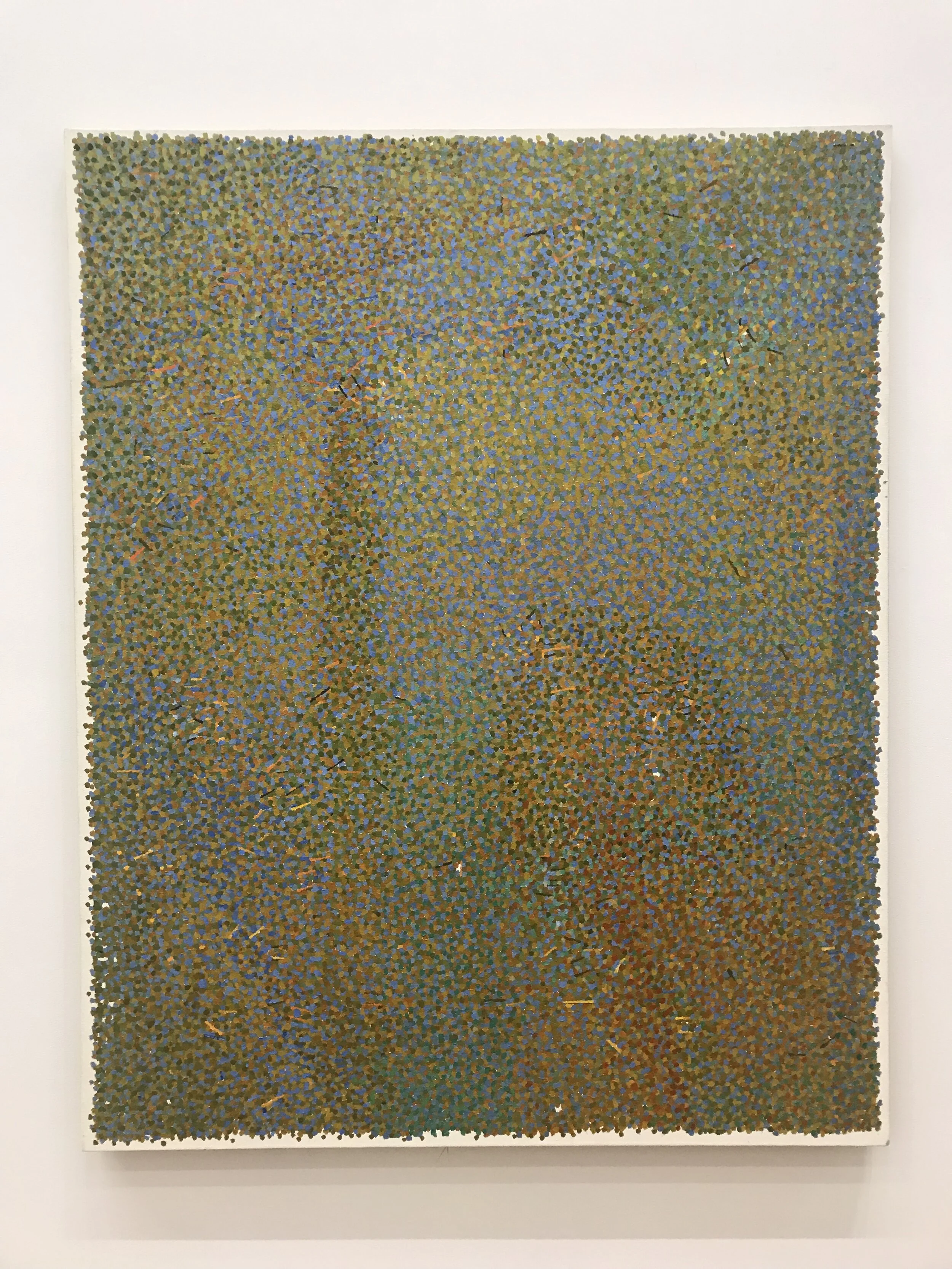
These are perfect paintings. They’re like the sensation of when your eyes finally settle in a dark room. They emit a soft buzz. Pattern Esque but not following a pattern logic or rule they’re more of a field logic but with shifting depths, not unlike an auditory experience of thousands of chirping grasshoppers but less violent. They’re the size of large televisions or mini movie screens with a similar proportion but they provide more flicker. 

I do love Seurat and Signac but although their pointillism was a stylistic breakthrough and there is a certain level of depth their paintings lack air. Air in paintings is one of the hardest things to talk about but when one sees it it’s undeniable. It’s an experience of the space between the physical eye and the “object”. Air, ether, atmosphere - these are words but the visual experience feels like something else. Part of it is a flickering, softer edges, not a rigid picture but something more fluid, hazier, not hard definitions but an openness to shifting barriers. Again these are just words. I find it very hard to verbalize air and it’s perceived and created qualities. Even though I can’t describe painted air - Andrew Forge’s paintings have It.

I particularly enjoy these paintings because they give me a similar visual sensation of when I stare at the sky. There’s an ungraspable spatial dynamic that can’t be defined or named. These paintings feel found, there’s not a definitive architecture or planned substratum. They feel stumbled upon but by a blind man who can see with his feet. In forge’s paintings few of the dots connect, they all huddle or mingle and rub shoulders. What’s extraordinary is through these clusters of perfectly interacting colors they create a rich and profound deep shifting space. Color magic at its finest. 

These paintings aren’t massaged. The paint is matter of factly slapped on. The application can be seen as immediate or clumsy depending on how generous you’re feeling. You can see the raised mark of the paint and still almost hear the plucking it made getting beat off the brush onto the painting with a poke of the brush. 

There’s not a finesse in layer or stroke or edge to create space and light instead these paintings rely solely on color dynamics and subtle bundle discernment’s of slight variations of dot size shape and it’s huddled or slightly overlapping relation to another color shape. 

forge 3.jpg

The more monochrome paintings don’t hold me but the pieces where Forge weaves violets, and yellows, pinks and greens to create mesmerizing foggy visual

homes are fascinating to travel through. “September 95-96” is one of these. It’s almost an after image in Bonnard’s retina after he spent all day painting his lover standing at her toilet. The palette continues on but the figure has faded. Phantom form and phantom objects dissolved into the pinholes of the eye created by millions of piercing shining light rays.

Do these pieces exist as observation? As a code from the rods and cones that are still being processed? Are they after images of when you close your eyes and face the sun, The light seen through your red fleshy eyelids but also something else? 

In a way it doesn’t matter. They’re spontaneously orchestrated symphonies of visual phenomena that are a joy to experience. As long as our eyes can see they should be given gifts. Andrew Forge’s paintings are just that.

Rackstraw Downes at Swarthmore College

March 10, 2020 Peter Makela
RD1.jpg

Having spent a lot of time road tripping through this country I have driven past countless scenes like this, but to be honest I have never given them the time of day. Endless telephone wires, one homogenous tower after the other, a pump house, McMansions, another gas station, my impulse was always to get to the desert or the woods as fast as possible to flee this type of modern industrial drudgery.

Read more

Turner’s "East Cowes Castle: The Regatta Starting for their Moorings”

March 9, 2020 Peter Makela
Turner 1.jpg

Turner’s “East Cowes Castle: The Regatta Starting for their Moorings” helps me have a lot more empathy for the Lepidoptera because like them I am drawn right to the light in this piece and I can’t escape.

This painting has the most awesome and seductive light. Sitting in front of it i’m completely hypnotized and transfixed by it. Nothing else matters. I don’t have to think about anything I can just rest in this perfect luminosity. thoughts that arise can be carried off by the river or dissolve into the sun and I’m just left to rest in this perfectly illuminated spaciousness.

Read more
Tags Turner, East Cowes Castle, Victoria and Albert Museum, London

Poussin's "The Triumph of David"

March 9, 2020 Peter Makela
P 1.jpg

Even though this is meant to be a triumphant scene where David is supposed to be the victor I can’t help but be drawn more to Goliath. I feel compassion for this beheaded man. I see the suffering and pain in his face which has far more humanity in it than the supposed victor who is parading his head on a stick.

Read more
Tags Poussin, Neoclassical, Dulwich Picture Gallery

Canaletto at the Wallace Collection

March 9, 2020 Peter Makela
C1.jpg

It’s incredibly difficult to paint the sensation of staring at the sky for a long time but Canaletto captured it in this piece. Space, thoughts, the movement and transformation of thoughts, space.

Read more
Tags Canaletto, Venice, Painting

Morandi at Tornabuoni Art London

March 9, 2020 Peter Makela

I suspected that this is a perfect painting but after sitting with it I am now certain. The cluster reminds me of the naked ancient remnants of the forum. Like those ruins I saw as a kid these too possess stories and a hidden life I will never be able to decode. The vessels are open but I am never granted the opportunity to look inside. 

Read more
Tags Morandi, Tornabuoni, London, Italy, Modern Art
Comment

Tate Modern

March 9, 2020 Peter Makela
morandi 1.jpg

It’s interesting being at the Tate modern, I absolutely do not care about 90% of the modern and contemporary art. I find most of it dead and boring and it doesn’t hold my attention. I don’t want to look at these opaque walls.

Read more

Bellini's "The Assassination of Saint Peter Martyr”

March 9, 2020 Peter Makela
Bellini 1.jpg

It’s always interesting to see what I want to see and connect with in the museum. There are many old friends who I respect but who I don’t particularly want to spend time with.

Read more
Tags Bellini, Painting, Renaissance, National Gallery, London
1 Comment

Powered by Squarespace