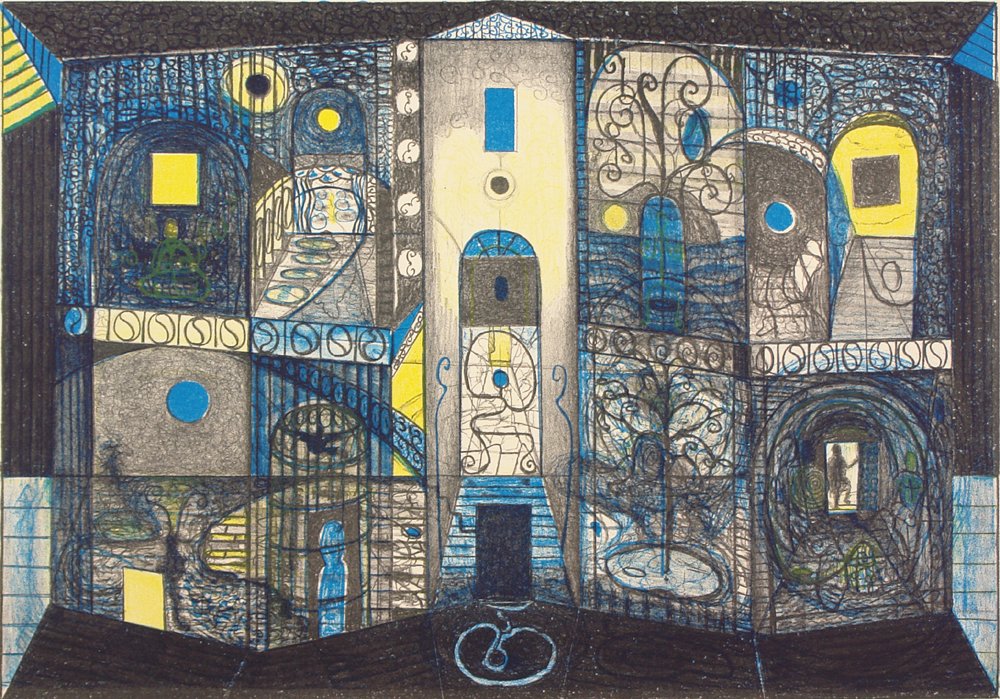
I had the pleasure of spending time with Richard Hull’s Play (1989) in the Chazen Museum of Art’s Prints and Drawings Room. It is a wondrous and deeply strange print. Even the title feels ambiguous, hovering between noun and verb. Is this a place, or an action? A constructed environment, or a psychological state?
The image presents something like an architectural structure, perhaps a playset or a paper maquette, but one that feels unsettled, almost nightmarish. It evokes a kind of waking dream or a psychic diagram. The space is divided into multiple compartments, roughly symmetrical yet internally unstable. Each room contains its own logic, its own marks and rhythms, yet none of them fully resolve.
It reminds me of the kind of drawing a child might make when asked to depict a house, except here the structure is fractured, recursive, and deeply interiorized. Lines break across planes, spatial boundaries collapse, and each compartment opens into further dimensions. There is no stable ground. Instead, there are layers of marks, trails, and reversals that both construct and undo the space at the same time.
Hull’s mark-making is particularly compelling. At first glance, it can appear almost casual, even unrefined. The longer one looks, the more sophisticated it becomes. The accumulation of lines, repetitions, and ghost-like overlays creates a dense visual field. With a limited palette of black, blue, yellow, and the white of the paper, he builds a surprising depth. Colors bleed into one another, generating secondary tones and atmospheres that feel almost alchemical.
In the center, there is a strange sigil-like form, something between a chair, a brain, and an emblem, framed within an arch. Beneath it, a mirrored or inverted space suggests a reflection or perhaps a portal into another dimension. Throughout the composition, there are continual reversals. Light becomes dark, interior becomes exterior, and spaces fold into themselves.
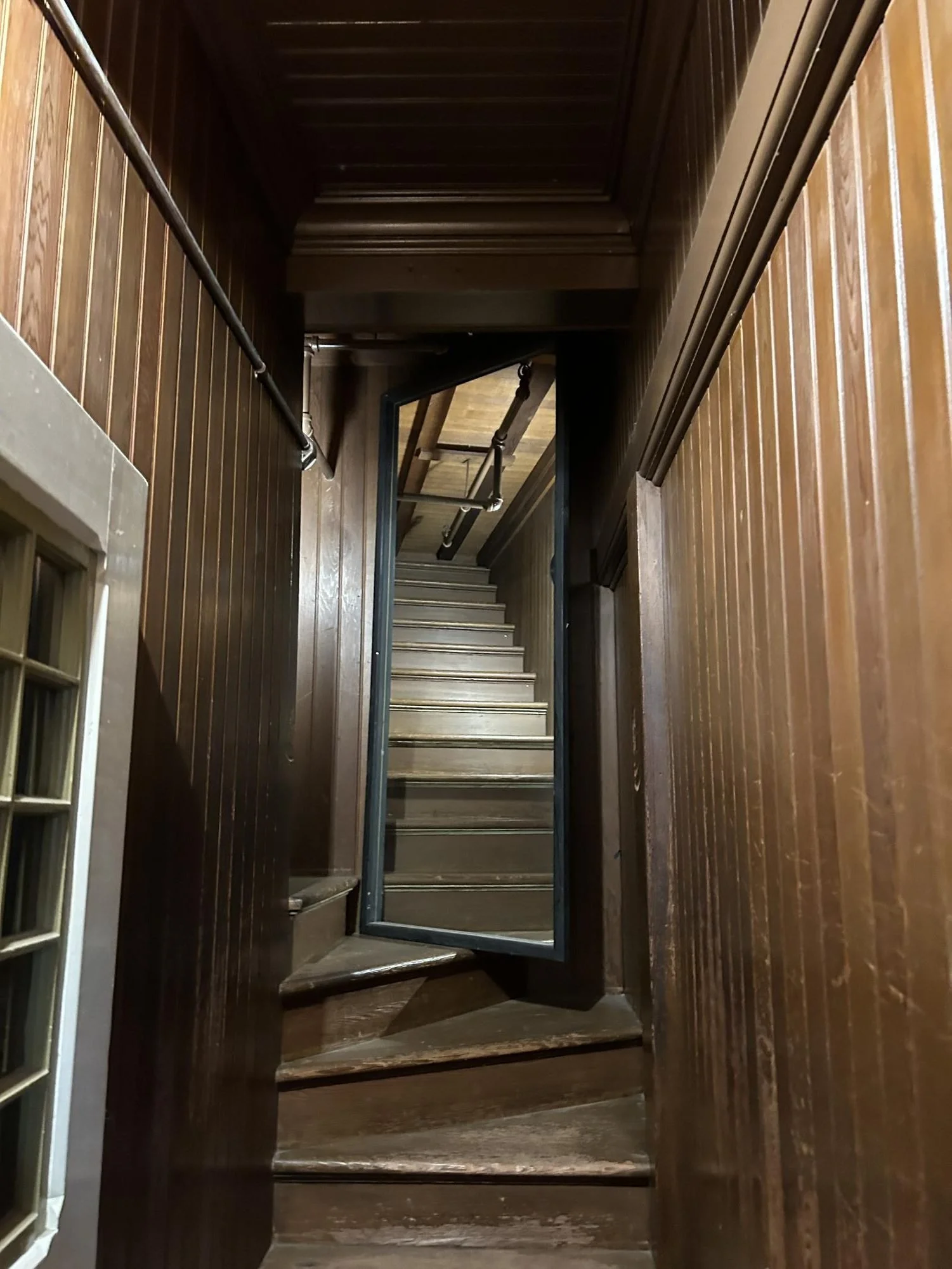
Stairs leading nowhere from the Winchester Mystery House
The structure recalls something like the Winchester Mystery House, with its endless additions, staircases leading nowhere, and rooms built for unseen presences. There is also a theatrical and slightly uncanny quality, reminiscent of The Cabinet of Dr. Caligari, where architecture itself becomes psychological.
The imagery is filled with ambiguous forms. In the upper left, a small green figure sits beneath a yellow square that could be a window, a symbol, or even some sign reflecting their mental state. Circular forms throughout the image oscillate between moons, windows, and eyes. In the lower left, ghostly shapes hover between shadow and presence. Iron gate-like structures appear in the upper right, recalling both decoration and containment.
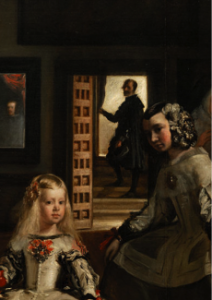
Detail of Jose Nieto Velazquez from Diego Velazquez’s Las Meninas
And then there is the figure in the doorway at the lower right, one of the few clearly legible forms in the composition. This figure immediately recalls the doorway figure in Las Meninas by Diego Velázquez. In that painting, José Nieto Velázquez stands at the threshold between spaces, suspended between entering and leaving, interior and exterior. Pablo Picasso, in his reworking of Las Meninas, retained and emphasized this figure as a crucial structural and psychological element.
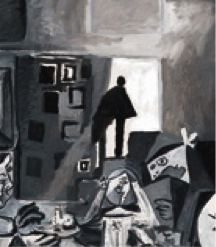
Detail from Picasso’s reworking of Las Meninas
Hull’s figure functions in a similar way. It anchors the composition while also destabilizing it. It introduces a liminal presence, a figure that connects spaces but does not belong fully to any of them. In the context of this already fractured architecture, the doorway becomes not just a passage but a site of ambiguity, tension, and possibility.
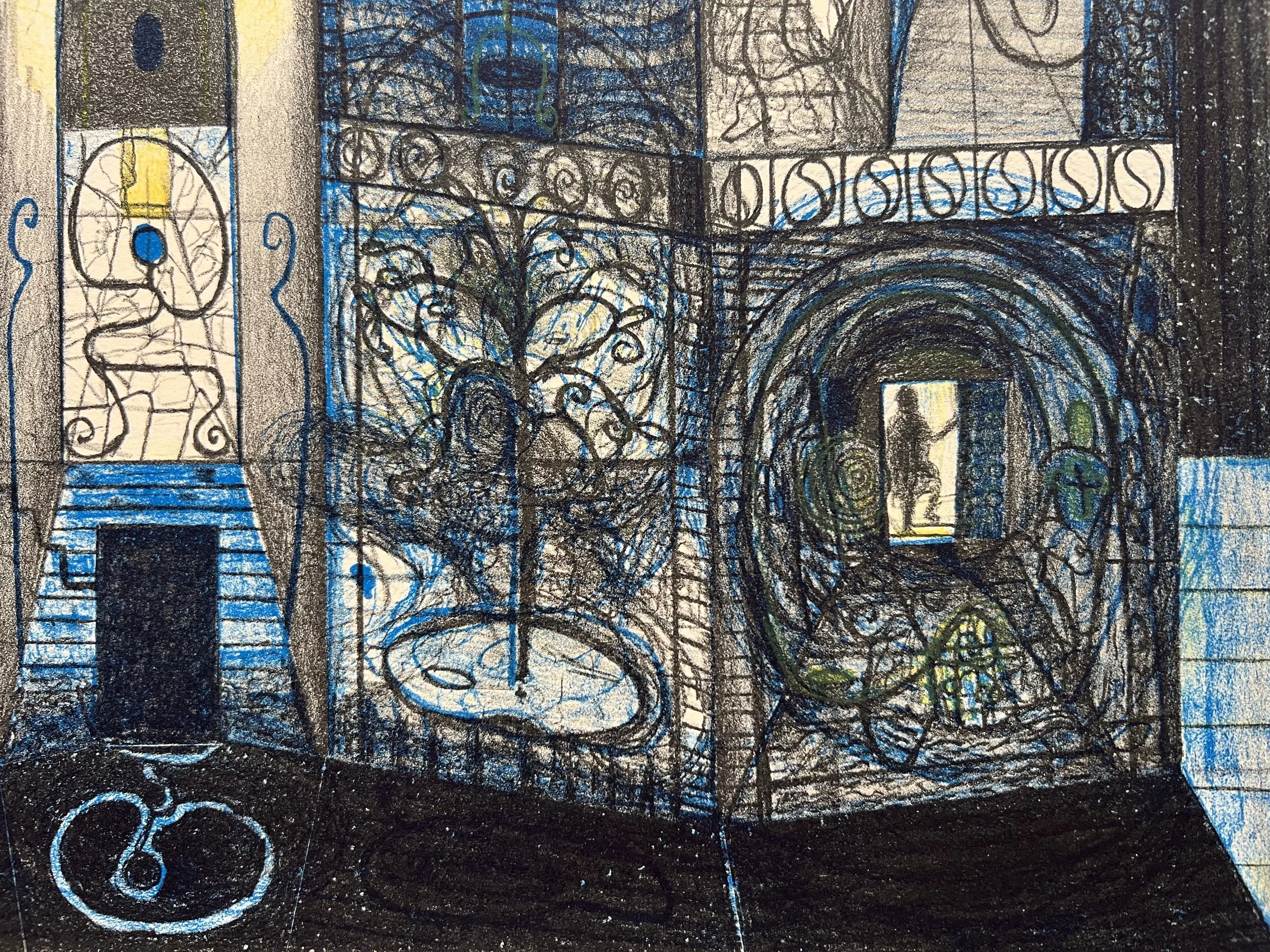
Detail from Richard Hull’s, Play (1989)
What is striking is how the image resists resolution. The more one looks, the more it opens, but it does not clarify. It remains ambiguous, porous, and alive. There are no definitive answers, only pathways, marks, and shifting relationships.
Richard Hull was one of my professors at the School of the Art Institute of Chicago, and he had a powerful impact on how I think about space. He often spoke about early Sienese painting and the way space could be constructed and negated at the same time, how multiple spatial logics could coexist. That sensibility is very much present here. The image builds space only to undo it, again and again.
He also emphasized the development of a personal lexicon of marks, and this print feels like a living example of that idea. Each line and each form contributes to a language that is both structured and open-ended.
It is a pleasure to return to his work more than twenty years later and continue to learn from it. The print does not settle. It continues to unfold.