Last week I had the privilege of visiting the prints and drawings room at the Madison Museum of Contemporary Art through the generous invitation of Paul Baker and Marilyn Sohi. I am deeply grateful for their kindness in making that visit possible. I was also able to spend time in the vault, encountering an extraordinary collection of Chicago Imagist works, well over a hundred pieces by many of the artists I admire, some of whom were also my professors. To see their work gathered together in that way was genuinely moving, and I will write more in the coming weeks about several of the works that stayed with me.
This painting by Roger Brown was not the first I intended to write about. But given the tone of today, it is the one that returns.
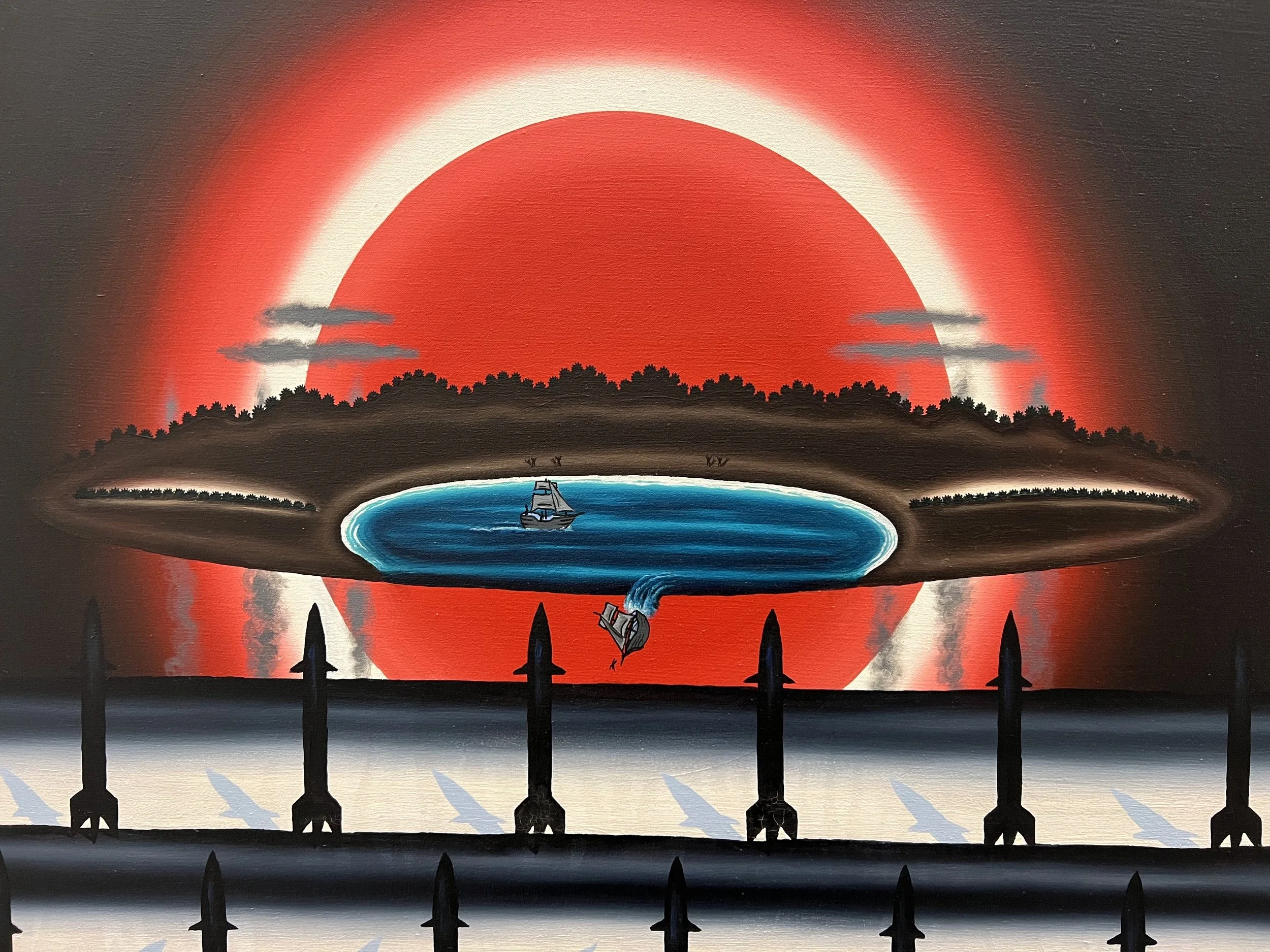
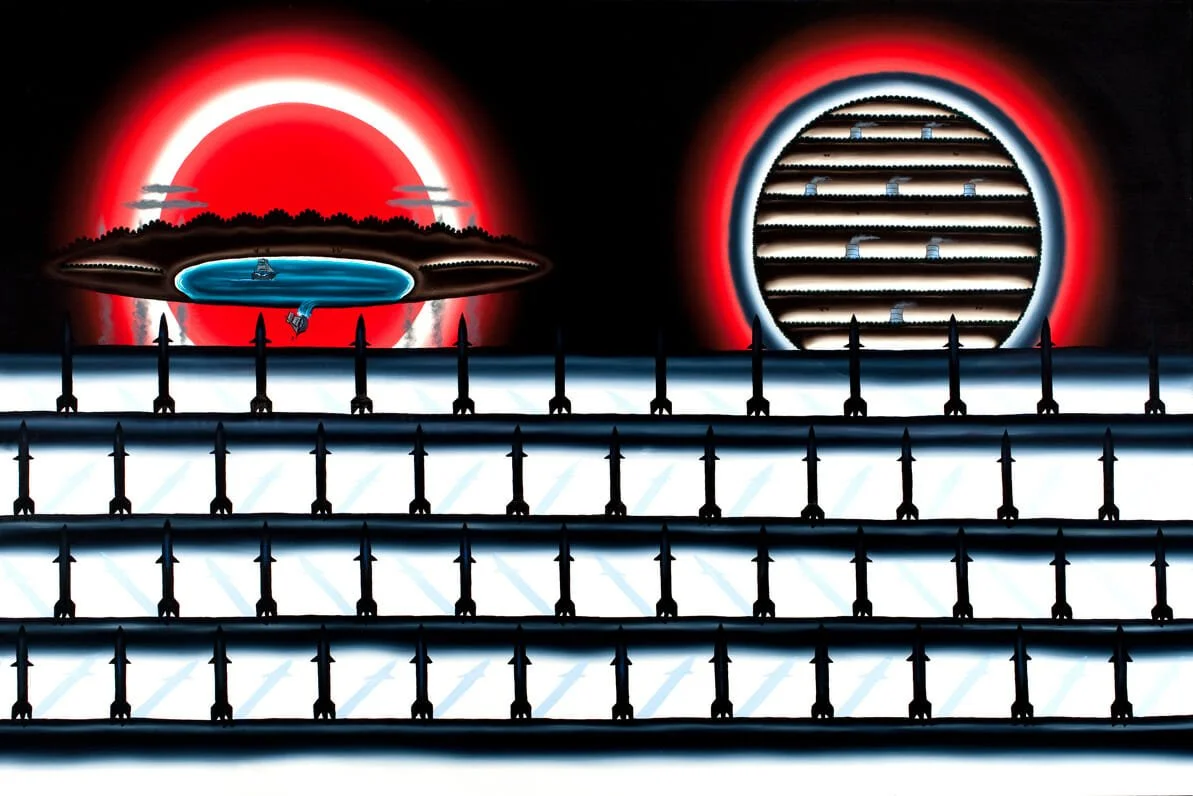
Welcome to Siberia, The Nuclear Freeze, The Flat Earth Society, No Nukes and The Dark Ages (When the Earth Was Flat and the Evening Sun Was Red From Looking Down Into Hell) (1983) is a deeply unsettling work. Seeing it in person, its clarity and force are almost overwhelming. The painting emerges from the atmosphere of the Cold War, when the nuclear arms race produced a pervasive and existential fear. But it does not feel confined to that moment.
The surface is structured by a relentless grid of missiles, repeated across the foreground like a mechanized field. This repetition transforms instruments of destruction into a pattern, something systematized, normalized. Above this field, two circular worlds hover, sealed off from one another. They do not communicate. Their only shared ground is the accumulation of weapons below them.
On the left, what at first appears as a flattened, mythic landscape reveals itself more precisely as a “flat earth,” held beneath a vast, descending red sun that reads almost as an aperture into hell. Smoke rises from the missile-filled ground, binding this world to the same machinery of escalation below. It begins to feel less like a landscape than a condition of belief: a closed system sustained by willful denial. In that sense, the image suggests not only ignorance, but a collective form of it, a society organized around the refusal of reality. Such a condition forecloses any possibility of recognizing interdependence. To deny the world is to sever relation, and from that severance follows destruction, not only of others but of the shared ground itself. The image holds that trajectory with disturbing clarity.
On the right, the world is entirely given over to nuclear infrastructure: a field of power plants extending without horizon, stacked and repeated within a closed sphere. There is no sky. No atmosphere. No opening. If this is a vision of advancement, it is a deeply claustrophobic one. The space is sealed, self-contained, endlessly productive in a way that feels both mechanical and unthinking.
The color reinforces this condition. The synthetic blues and the heavy, atmospheric red produce a palette that feels chemically altered, removed from any natural register. It is not just that the landscape is artificial, it is that perception itself has been estranged. What remains is a system that builds upon itself: power plants above, missiles below, a continuous field of mechanized intention.
What is most striking is the separation. Everything in the painting is divided: the canvas, the worlds, the systems of belief. There is no exchange, no permeability, no shared space. Only distance, and the quiet, accumulating presence of force.
Standing before the painting, it is difficult not to feel its continued relevance. What may have once seemed like the extremity of another era no longer feels so distant. The work does not simply depict fear; it diagrams it. It shows a world in which perception has been flattened, systems have closed in on themselves, and the horizon is defined by escalation, repetition, and a kind of mechanized ignorance.
It is a dark painting, but it is also a precise one. Though it was made more than four decades ago, it feels uncannily fresh, perhaps even more so now. Time here does not feel linear, but recursive, moving in curlicues, returning us again and again to the same thresholds. And so the question it leaves is not only historical, but immediate: how can we begin to resolve the conditions of aggression and ignorance, both within ourselves and collectively? Again and again, we seem to push history to the brink, poised between mutual destruction and the possibility of mutual benefit.